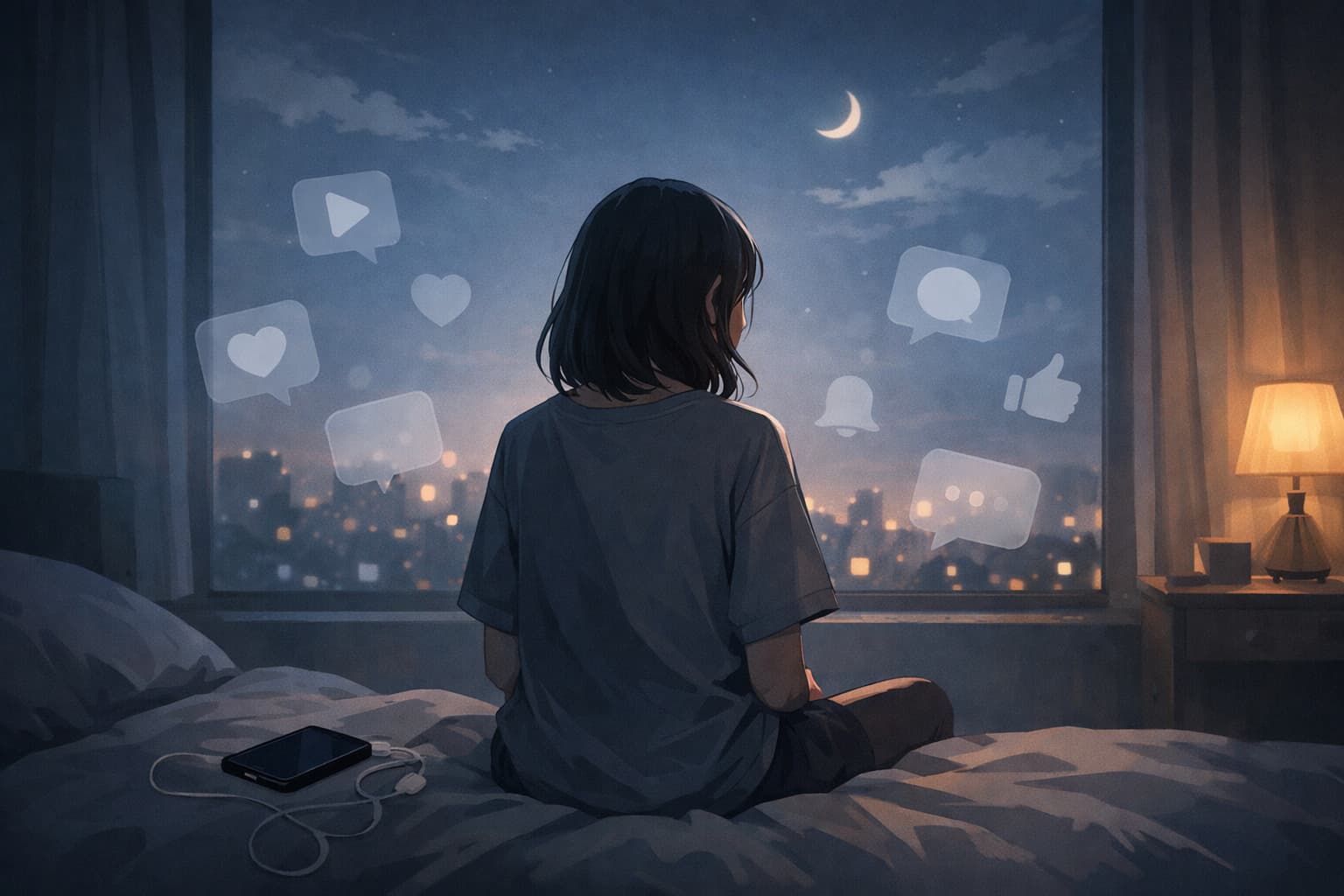
Why You Feel Empty After Scrolling Short Videos
“The true currency of life isn’t money, or even time. It’s attention.”
It’s 11 PM. You’re lying in your rented apartment, you pick up your phone, and all you wanted to do was check whether it’ll rain tomorrow.
Then you catch a 15-second video. Kinda interesting. Then another. Then another. Some of them you swipe away before they even finish. By the time you finally set the phone face down on your chest, it’s 1:40 AM. You close your eyes and your brain is full of fragments of what you just saw, but you can’t recall a single one of them clearly. When the alarm goes off the next morning, you feel wrecked.
I’ve been there more than once.
You’re already exhausted, so why can’t you stop?
It’s Not That Your Willpower Is Weak. The Opponent Is Just That Strong.
You worked a full day. Meetings with coworkers, back-and-forth with clients, a pile of random stuff to handle. Every one of those things required you to judge, to choose. By nighttime, your brain has burned through most of its “active choice” budget.
That’s when short video shows up. It doesn’t ask anything of you. No choice, no thinking. Flick your thumb, get a reward. The most exhausted moment of your day happens to be the moment it’s easiest for it to land.
Every social media company’s AI is in an all-out arms race—whoever can hijack your dopamine best wins. This isn’t a conspiracy theory; it’s just the business model. Some of the smartest engineers on the planet spend their days figuring out how to make you swipe one more time, linger one more second. As regular people, going up against that barehanded, we don’t win.
What You’re Actually Losing Is More Than Those Two and a Half Hours
Most people think scrolling short videos is just wasting a bit of time.
But think about it. Have you noticed that lately, when you try to read an article that’s a little long, you start wanting to swipe away halfway through? A video over two minutes feels too long, you want to drag the progress bar? When a friend talks to you for more than thirty seconds, your mind starts drifting?
You weren’t always like this. You used to be someone who could sit through a two-hour movie in silence. Someone who could stay up all night talking with a friend.
You didn’t get dumber. Your brain got retrained.
When a brain gets used to a hit, a reward, a dose of novelty every fifteen seconds, its threshold goes up. After that, anything that requires five or ten minutes of continuous focus before paying off feels like punishment. You can’t sink into a book. You can’t sit still to learn something. You have no patience for working through a plan.
That is what you’re actually losing. Not two and a half hours—your capacity for deep thought, your patience to sit still, and your ability to do the things that only pay off when you stay with them for a long time.
Attention Is All We Have
Naval said it: “The true currency of life isn’t money, or even time. It’s attention. Money matters, but it can’t buy time. And time itself isn’t really the point, because if you aren’t actually present, that stretch of time is hollow. What you truly own is your attention. You choose where to put it and what to do with it.”
How you spend it is up to you. There’s no right or wrong.
But be careful—attention is the only thing you have.
What Short Video Really Damages Is Teenagers
Naval says how you spend your attention is your own freedom. But that comes with a prerequisite: you have to be capable of choosing.
We’re adults. At minimum, we can take responsibility for our own choices. But think about kids who are thirteen or fourteen. They haven’t even formed basic judgment about the world, they haven’t figured out what “choosing” actually means, and they’re already trapped in the machine.
Short video hands them a fake “success mirage.” Inside the algorithm’s filter bubble, what do they see every day? Some kid who didn’t finish middle school acting like a fool on camera and racking up millions of followers, driving a sports car and selling stuff on livestream. A seventeen-year-old girl pulling in huge tips by posting suggestive videos.
A teenager watching that will instinctively think: that internet celebrity can barely read and makes hundreds of thousands a month just shaking his ass, so why am I getting up early every morning to memorize English vocabulary? Why am I eating the hardships of studying?
Honestly, studying is already anti-human. It asks you to sit still, endure boredom, solve a math problem today that might only pay off years later in an exam hall. Short video? A hit every fifteen seconds, zero cost, zero barrier. Put those two things in front of a teenager and the outcome is decided before the game even starts.
They can’t see the one-in-a-million survivorship bias behind the screen. They can’t see the capital machinery packaging the whole performance. All they believe is the “shortcut” their own eyes just showed them.
Our generation at least had basic cognitive scaffolding in place before short video hit. But today’s teenagers are being formatted before their cognition is even formed. This isn’t a self-control problem. It’s the base operating system of an entire generation being rewritten.
So parents should strictly limit how much short video their kids consume. The social media AIs are in a frantic race to hijack attention, and if grown adults can’t resist it, don’t expect a thirteen-year-old to.
From “Being Fed” to “Actively Thinking”
Back to us.
I’m not going to tell you to “put down your phone and read a book.” That’s correct and useless. You can’t do it. I can’t either.
But there’s one small thing you can try: next time a video catches you, don’t swipe away immediately—try writing a comment instead.
Not “lol” or “so true.” Something you actually thought about and put into your own words. Push back, add to it, or just restate the video’s point the way you’d say it.
The action looks tiny, but it changes one thing: your brain switches from “passively receiving” to “actively thinking.” You stop being the finger that swipes through video after video and become a person who’s thinking.
If you find writing comments gets addictive, go one step further: try making something yourself. It doesn’t have to be polished. A paragraph, a note, a single opinion is fine. A lot of creators doing well today started out as “killer commenters” in someone else’s comment section.
Scrolling short videos lets the algorithm feed you. Writing is you choosing what to think about and what to say. The first you won’t remember anything of the next morning. The second becomes part of you.
The algorithm that thinks for you erodes you. The algorithm that thinks with you settles into you.
When you really sit with that empty feeling after scrolling, most of the time it’s not because your time got stolen. It’s because during that time, you didn’t leave anything behind.