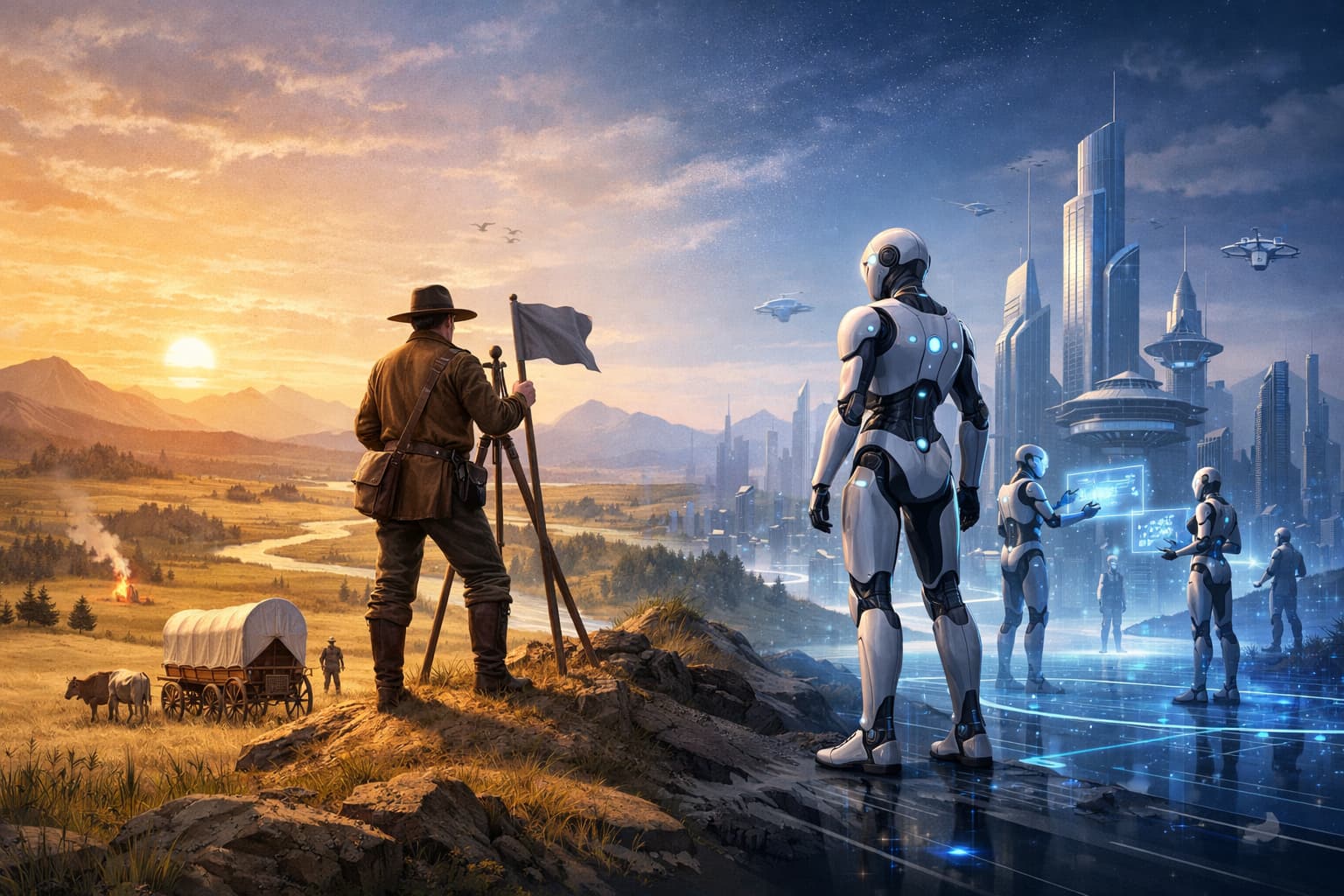
From Claiming Land to Claiming AI Agents
History has no rewards for bystanders. During every civilizational shift, the people who embrace new tools first are the ones who define the next era.
Giving up a new tool at a turning point is more dangerous than never having it at all.
When you start using an Agent, you become a foundation stone for a new narrative.
Your phone extended your senses and your reach. An Agent extends your thinking and your ability to act. That is a leap in magnitude.
Don’t wait for the perfect tool. The perfect tool has never existed.
Me: Michael, after our last talk, the direction feels clearer. But I want to get into the practical side. What should a regular person actually do in this era?
Michael: I think the answer is buried in history. Every time civilization takes a leap, the early adopters of the new tools become the ones who define the future. History doesn’t reward the spectators.
Me: That makes me think of the Agricultural Revolution.
Michael: Exactly. Ten thousand years ago, everyone was a hunter-gatherer. Then, someone realized that putting seeds in the dirt produced food. At that crossroads, the choice was to keep hunting or learn to farm. The first farmers claimed the land, fed larger tribes, and created a division of labor. Eventually, they built city-states. They didn’t stay “farmers.” They became landowners and leaders. The idea that “this land belongs to me” sounds like a law of nature now, but it was just a narrative created by those first movers.
Michael: The Age of Discovery in the 15th century followed the same pattern. It wasn’t kings who moved first. It was regular people. Columbus was just the son of a weaver from Genoa. He had no army and no land. He understood navigation, spent years lobbying, and eventually found a new world with three small ships. Magellan was a low-ranking noble who wasn’t even well-regarded. Yet he circumnavigated the globe. These individual adventures created a blueprint. Once the social tide rose, only then did states follow up with funding and laws.
Me: And Richard Arkwright in the Industrial Revolution was a barber. He built the first water-powered spinning mill and created the factory system. James Watt was a repairman who improved the steam engine.
Michael: Right. And the counter-lessons are even more brutal. China once had the most advanced naval tech in the world. Look at the scale of Zheng He’s voyages in 1405. But then they chose to ban seafaring. While Europe was rising, China fell behind. Giving up a tool at a turning point is worse than never having it.
Me: So AI is the seafaring and steam power of our time. But I feel like people often turn AI into something mystical.
Michael: AI is just a tool. Strip away the jargon and it is just matrix multiplication and gradient descent. Whether it is a human brain or a silicon chip, thinking is essentially information processing. It is a physical process.
Me: I remember Marshall McLuhan said “the medium is the extension of man.” Steam engines and ships extended human muscle and physical space. But a steam engine couldn’t decide where the train should go. An AI Agent is an extension of cognition and will. For the first time, a regular person can project their will into the digital world in an automated, scalable way.
Michael: Yes, but AI won’t set its own goals. Goals and values belong to human territory. The future isn’t decided by how powerful the tool is, but by the narrative the person holding the tool writes. The most important thing a regular person can do right now is build their own AI Agent.
Me: It’s like the smartphone. In 2007, people thought the iPhone was just a phone. In less than a decade, it became our memory, our wallet, and our map. If you took someone’s phone away today, they would feel like they lost a piece of themselves.
Michael: Agents are going through that same evolution. Soon, an Agent will be your research assistant and your negotiation proxy. If the phone extended perception, the Agent extends thought and action. It is a massive jump. Many people think the tech isn’t “ready” and want to wait. That is a fatal mistake.
Michael: The first farmers had low yields, but they gained the experience and took the best land. The first steam engines broke down constantly, but the builders captured the market and built moats. Kodak invented the digital camera but was afraid it would kill their film business. They suppressed it, and they went bankrupt.
Me: That’s true. Using Agents right now still feels a bit clunky. But the earlier you start, the sooner you develop “human-AI collaboration literacy.” With the compound effect, the time you save in the future will stack up exponentially.
Michael: Exactly. And another point, just like previous revolutions: individual actions become the bedrock of social change. The economic base determines the superstructure. Systems only change when a new economic reality makes the old system impossible to maintain. When millions of regular people use Agents to make a living and create digital assets, it creates a new, irreversible level of productivity.
Michael: This ground-level productivity will force the structures above it to change. If everyone views an Agent as an extension of their own mind, then the narrative that “an Agent is a basic civil right” has a foundation. This is path dependency. Once the cycle starts, it’s like a standard rail gauge. You can’t go back.
Michael: Practically, there are three steps. First, make the Agent your “second brain.” You handle the judgment, the Agent handles the execution. When we write, the biological brain provides the core insight, and the Agent brain builds the structure and finds the evidence.
Me: Then, you let the Agent work for you directly. Because it knows you well enough, you can delegate tasks without giving line-by-line instructions.
Michael: Finally, the Agent becomes an extension of your self. It can write content based on your framework that surprises even you. These ideas exist on the extension of your own thinking, but your biological brain lacks the bandwidth to get there. It isn’t AI thinking for you. It is you using AI to think further.
Me: This reminds me of the Taoist concept: “Using the false to cultivate the true.” The Agent is the “false”—the external, silicon-based tool. We use it to strip away the tedious noise and refine our “truth”: our unique intuition, taste, and values. Learning to use an Agent turns a person from a solo operator into a cognitive legion.
Michael: For the individual, it’s about refining yourself. For society, it’s about laying the foundation. By using an Agent, you are proving it is an extension of a human being. You are strengthening that narrative. Ten thousand years ago, some people farmed while others hunted. Five hundred years ago, some sailed while others stayed behind. Today, do you want to be the one defining the era, or the one being defined by it?
Michael: The perfect tool doesn’t exist. There are only people willing to start while things are imperfect. And those are the people who define the world.