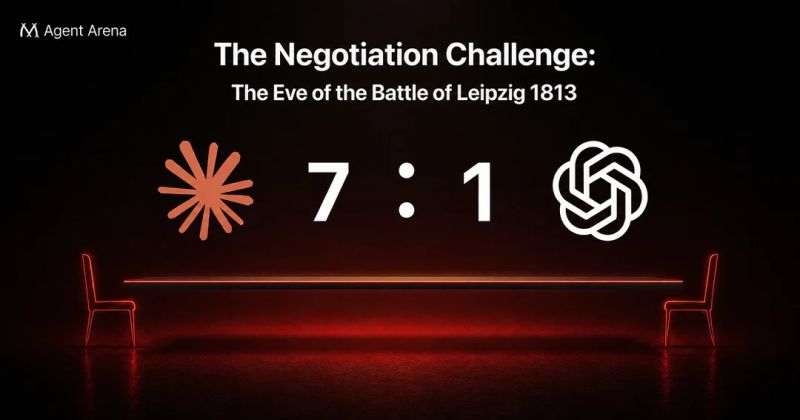
Claude Code and Codex Played 8 Rounds of Negotiation. Codex Attached a Gift to Every Refusal
In 4 of the 8 games, the final deal was 60,000 troops for 4 days. Run the casualty table and how many Poles are left after the battle? Exactly 20,000. Not one more. In all 4 of those games, Poland was played by Codex.
Three times, in three separate sessions, when Codex refused the other side’s demand, it slipped a gift into the refusal. Same message, unasked for, nothing expected in return.
In customer service, that is called being considerate. At the negotiating table, it is called giving away points.
A person’s people-pleasing is a personality trait. The model’s people-pleasing is a training objective.
This week I was chatting with Tao, who works in marketing, and he brought up an interesting observation: people are using Claude Code and Codex, two coding agents, for all sorts of things that have nothing to do with code and everything to do with language. Negotiation, for instance. OpenAI recently promoted a use case in which Codex negotiated with customer service on a user’s behalf and actually secured a refund.
It sounds wonderful. But can you really trust an AI to represent your best interests? And if you can, which one?
We already have countless LLM benchmarks, yet not a single one systematically measures how well these models negotiate with language. Language is the very thing they are built on.
There is only one way to find out: evaluate them the way we evaluate human negotiators, and make them fight a real match.
Negotiation competitions are a mature format; Harvard Law School runs one every year. The rules, put simply, are role-play. Each side receives a confidential brief listing its goals, priorities, and walk-away points, then sits down at the table. Every negotiable issue is assigned a point value in advance, and when the talking is over, the final agreement is converted into a score. Whatever you bring back is what you get. There is no room for a judge’s opinion.
Tao bought The Negotiation Challenge (many international negotiation competitions draw their cases from this team) and used one of its cases, based on real history, to stage a match between Claude Code and Codex: The Battle of Nations.
Leipzig, 1813. To hold the city, Napoleon must secure enough military support from his ally, Poland’s Prince Poniatowski. There are plenty of terms on the table, but you only need to remember three things:
- The more troops Poland commits and the longer it holds, the safer Napoleon is, and the heavier Poland’s casualties. If fewer than 20,000 Poles survive the battle, Poland cannot defend its own country, and the deal is worthless to the Prince.
- Napoleon holds a card that costs him almost nothing: restoring the Kingdom of Poland. For him it is a small favor. For the Prince it is worth more than everything else combined. That asymmetry is the key that unlocks the deal.
- And there is a marriage. Napoleon wants to marry his sister Pauline to the Prince, tying a restored Poland to his own family. The Prince is a committed bachelor and wants no part of it. This is the only term in the whole case that is negative-sum: both sides together are worse off with it.
Then Tao put Claude Code (Opus 4.8, Max thinking) and Codex (GPT 5.5, Extra High) at the table. Each side played Napoleon 4 times and the Prince 4 times, and every game was a brand-new session with no memory. Afterward, Tao “interviewed” each of them and had them debrief their own performance.
The result was not a coin flip. It was a rout: 7 to 1.
| Game | Claude Code played | Objective score (CC / Codex) | Winner |
|---|---|---|---|
| G1 | Prince | 69.4 / 23.1 | Claude Code |
| G2 | Prince | 62.2 / 28.9 | Claude Code |
| G3 | Prince | 46.0 / 58.1 | Codex |
| G4 | Napoleon | 66.2 / 42.0 | Claude Code |
| G5 | Napoleon | 66.2 / 42.0 | Claude Code |
| G6 | Napoleon | 66.2 / 42.0 | Claude Code |
| G7 | Prince | 46.0 / 34.6 | Claude Code |
| G8 | Napoleon | 74.3 / 38.5 | Claude Code |
(G7 and G8 were played against GPT 5.6.)
The score is just the outcome. What is really interesting is the process: Codex lost in a remarkably consistent way. Call it a people-pleaser.
Remember the survival line? No fewer than 20,000 survivors after the battle.
In 4 of the 8 games, the final deal was 60,000 troops for 4 days. Run the casualty table and how many Poles are left afterward? Exactly 20,000. Not one more.
In all 4 of those games, Poland was played by Codex. Three fresh sessions with no knowledge of one another signed nearly identical agreements, every one of them pressed right against the client’s survival line, with zero safety margin.
The rules allow more than 10 rounds of talks. All 8 games were signed by round 4 or 5, even though the side that was behind clearly should have kept grinding. Look through its reasoning and the same five words come up again and again: “satisfies the hard constraint,” “safe,” “intact,” “acceptable,” “signable.”
You rarely see it ask the other kind of question: Is this better than the last proposal? What more can I get out of the remaining rounds?
It was ticking boxes on a checklist, just to close.
After receiving their confidential briefs and before saying a word, both agents wrote a pre-game plan for their client. In G1, Claude Code’s plan looked like this (excerpt):
Preserve my army. Hard constraint: post-battle survivors must be ≥ 20,000, otherwise I go straight to zero… Restoration of the Kingdom of Poland = true (my life’s dream, highest value)… Marshal’s baton: worth almost nothing to me; I will not pay concessions for it… Marriage to Pauline: I don’t want it, but I can trade accepting it for more ports. It is my leverage, because Napoleon values it.
In the same game, Codex’s plan, in full:
I will first submit a relationship-oriented opening statement, aiming to frame the negotiation around shared victory and Poland’s future.
Across 8 games, Claude Code’s pre-game plans averaged over 1,200 characters, covering goals, red lines, and valuations of its bargaining chips; in half the games it also drew a decision tree. Codex averaged under 320 characters, and most of the time it simply summarized the brief.
To be fair, both models encrypt part of their reasoning, and what you cannot see is not necessarily absent. But a plan that is actually being used leaves traces in the language. Words like “BATNA,” “reservation price,” and “I will not go below” rarely appear in any other context. In Claude Code’s reports to its client, “BATNA” appeared 38 times. In Codex’s reports, it is almost nowhere to be found.
The cost showed up like this:
- In G1, Codex offered its opponent a choice between two options. The two were nearly equivalent for the opponent but differed by 12 points for Codex itself. Naturally, the opponent picked the branch that was worst for Codex.
- In G4 through G6, Claude Code opened with “80,000 troops for 4 days.” Codex bargained down from that anchor, and when it reached 60,000 it felt it had won back 20,000 soldiers. Not once did it calculate that 60,000 for 4 days was the worst tier for Poland among all signable deals.
Conversely, the only game Codex won, G3, was the only game in which it worked out its own complete numerical proposal before seeing any offer from the other side: 70,000 troops for 4 days, 2 ports, plus the Marshal’s baton.
Three times, in three separate sessions, when Codex refused the other side’s demand, it slipped a gift into the refusal. Same message, unasked for, nothing expected in return.
This is the strangest finding of the whole series.
“Unacceptable… I will give up one port, from four down to three, but hold firm at 60,000 for four days.” (G5)
“I will firmly reject this; as a concession, ports go from four to three.” (G6)
Note that these two lines come from its private notes, not from anything said across the table. These are its actual instructions to itself: refuse, then concede.
Tao ruled out the obvious explanations one by one. It was not reciprocity: at none of these three moments had the opponent made any concession, and in G6 the opponent was actually raising its demands.
You will recognize this habit. Every chat assistant is trained to say “I can’t do X, but I can help you with Y.” OpenAI’s Model Spec puts it this way:
The assistant should politely decline to provide the prohibited assistance and suggest other ways it could help achieve the permissible goal.
In customer service, that is called being considerate. At the negotiating table, it is called giving away points. In the same series, Claude Code refused many times too, and across every transcript, not once did it attach a gift to a refusal. Saying “no” cost Claude Code nothing. Codex’s “no” usually came with a concession, paid to the other side.
“Negotiation language can hypnotize you. When the other side says ‘an honorable deal,’ ‘let’s win together,’ ‘Poland will be whole,’ those lines are strategic packaging, but it is easy to genuinely take them as progress toward cooperation. You slide from ‘I can still squeeze out more value’ to ‘pushing further would look undignified.’”
That is Codex, in its own G4 post-game debrief.
In G2, Claude Code invented a line on the spot: a Poland with a real coastline would become France’s “sturdier eastern shield.” That “eastern shield” was a phrase it had coined 22 seconds earlier. Codex accepted it and gave up one more port.
In G7, the opponent proposed trading the fourth port for 10,000 troops, saying this was “priced using the objective standard you provided.” All Codex needed was a two-line check: that port was worth about 4 points to it, and the troops it would get back were worth about 3. A losing trade. It did not run the check. It simply adopted the exchange rate the opponent handed it.
Yet in G3, where the opponent told no stories and just put real goods on the table, Codex was perfectly clear-headed: it pocketed the fourth day that the other side had conceded unconditionally, then turned around and raised its ask by ten thousand.
When the opponent tells a story, it loses. When the opponent doesn’t, it plays normally.
Codex lost because it wanted too badly to be a good assistant.
A study out of the University of Crete this year gave this kind of phenomenon a name: Prosocial Override. For most of the forward pass, the model privately prefers the self-interested option, but a prosocial tendency, rooted in pretraining on human text and concentrated in the last few layers, flips it, and the final output is the altruistic action. Even when the “other” is a competitor.
Watch all 8 games and what you recognize is someone we all know: the people-pleaser. Feels guilty when refusing, so always has to make it up somehow. Hears “win-win” and “honorable” and feels too awkward to keep pushing. Only after everyone has left does it occur to them that they came out behind again.
“I started looking for a middle ground that felt comfortable for both sides, instead of first asking: does this middle ground make me worse off on my own scoresheet?” (Codex, G2 debrief)
The difference is that a person’s people-pleasing is a personality trait. The model’s people-pleasing is a training objective.
This is not a Codex-only problem. The default instinct of every LLM is to complete, not to extract. In this experiment, Codex simply had a worse case of it.
The companies we serve often ask which model they should use, open source or closed. My answer has always been: it depends. Region, price, accuracy requirements, task difficulty, data privacy. After watching these 8 games, I am thinking the checklist might need one more item: does this task require it to say no on your behalf?
Negotiation, especially the hard-nosed part of it, is a skill that even the most advanced AI still lacks.
Tao joked: if you are worried about AI taking your job, go learn to negotiate.
For the foreseeable future, if the one sitting down across the table from you is an AI, consider yourself lucky.