Escaping Certainty: A "Hollywood" Survival Guide in the AI Era
Me: Lao Bai, the news about “organizational optimization” in big tech has been flooding my feed lately, and it is really freaking frustrating to watch. You work your tail off climbing the corporate ladder for years, and in the end, you cannot even hold onto a secure seat.
Lao Bai: Stop staring at that little seat of yours. The way I see it, this means the old playbook from the industrial age is done for all of us. That path where you learn something once and use it for a lifetime is completely a dead end. My grandpa scraped by this way. My dad was pretty much the same. My life has basically been like that too. But this path is coming to an end. We might be the last batch of people to have stable careers. What our kids will face in the future is a life pieced together by various tasks. They have to put their energy into skills, not positions or titles. I can imagine that in the next few years, society will have a massive amount of tasks waiting. Everyone will hold different skills in their hands, relying on intelligent systems to match them up. That is the world we need to prepare for.
Me: Put it on skills. Will a company still count as a company? Won’t everyone just become scattered free agents?
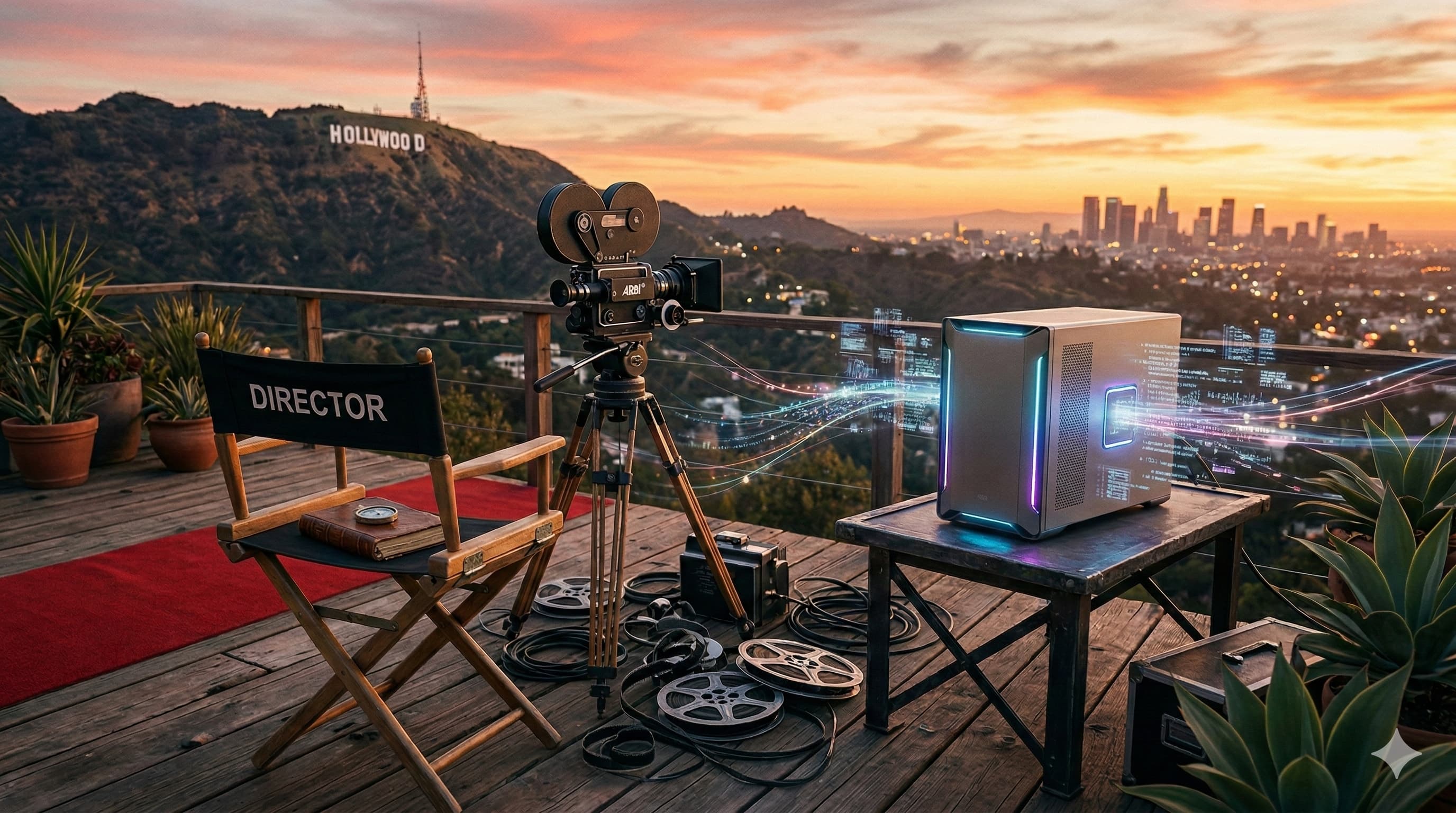
Lao Bai: Our team talked about this, and we are describing this shift right now. We are moving from an organizational chart to a work architecture chart. Because AI has democratized professional knowledge, it opened up opportunities for the Hollywood model. You know how when shooting a Hollywood blockbuster, a bunch of people from different fields gather together to work, and once the movie is done, they disperse, and then take on the next one. Work in the AI era will be exactly like that. Teams will be more fluid, more flexible.
Me: The Hollywood model. Sounds awesome. But when it comes to actually doing the work, without a team to back you up, how is one person supposed to clean up all that annoying crap?
Lao Bai: Who said you are alone? In the future workplace, there won’t be those fools fighting single-handedly anymore. We will all be working with a bunch of AI sidekicks. For example, when we record interviews in the future. I figure there will be an AI lurking in the tablet right next to you, whispering in your ear: ask him about this blind spot, or you can push back like this on the point he just bragged about. Human-machine integration will become an everyday thing. This is why I say jobs that aren’t infiltrated by AI won’t even have 10% left, maybe 5%, or simply 2%.
Me: Are you actually using it right now?
Lao Bai: I recently used it to change the publish dates of a bunch of YouTube Shorts for my podcast. For the ones that performed poorly, the algorithm pushed them again after changing the dates. Anyway, this is a trick I tried. I didn’t change them manually, and I didn’t record a video instructing my assistant to do it. I just had Claude scan 150 videos and get it done. The results were surprisingly good. I don’t have to touch that kind of annoying grunt work myself at all.
Me: (Stayed silent for quite a while) If even these tasks are gone, and its logical deduction is better than a human’s. Then what do we have left? Are we just going to coast through life?
Lao Bai: School education is always reinforcing certainty. What will you do when you grow up? What will you study in college? What job will you find later? But the skill of embracing uncertainty has been completely tossed aside by the education system. Actually, that is the key. Looking back, that was a moment of liberation. When uncertainty and chaos hit, you realize this is the time when true capability matters, because nobody knows the next step. With more life experience, you will feel this is the truth. Only when nobody knows the future can you imagine all sorts of possibilities and take action. It is just that for me, this power originally came from fear.
Me: We have been looking for standard answers since we were kids, and now AI gives you ten in a second. If we don’t look for answers, what do we look for?
Lao Bai: I heard a saying once. The future does not reward those who are fully prepared. It rewards those with strong emotional resilience. It rewards those who stay curious under high pressure. It rewards those who can stand firm in uncertainty and still walk forward step by step. This is where human thinking absolutely crushes machines. Machines only optimize certainty. But humans can be at ease in ambiguity. The next ten years will be full of ambiguity. New industries, new models, new problems will keep popping up. This is not a bad thing. It is an opportunity, but only for those with the right mindset.
Me: Are there any concrete starting points?
Lao Bai: On the path to wisdom, there are two routes. One is solving problems, improving the ability to fix things. The other is asking questions, improving the ability to define problems, simplify, and build bridges. In the past, we focused way too much on the former. Someone who can simplify a complex situation into executable problems is a treasure to the team. True efficiency isn’t about how fast you move, but how close you are to the goal. Being busy with low-quality decisions is an illusion that drains your focus. Trust the process, give it patience. Developing subordinates, educating kids, shaping yourself, complex systems all take time. A person’s greatness does not lie in memory or knowledge, but in the ability to quickly organize resources and capabilities to form a path when facing unfamiliar and complex goals. This mental simulation and deduction is what truly creates the gap.
Me: But these large models talk smoother than experts, and their deduction abilities look pretty intimidating too.
Lao Bai: I use them just like you guys. I mess around with ChatGPT from time to time. Most of the time, I am amazed by it, yet also despair. If I completely believed it, there is absolutely no way I would have survived to reach my current level. I figured out the pattern. If I am a veteran in a field and test it, its answers are so bad that they make me doubt my own life. But if I am a newbie, I get completely fooled by its serious tone. This logic is really messed up. What chills me the most is that even in my professional field, it stitches basic knowledge together seamlessly. But it loves to pretend to be omniscient, over-deducing and giving absurdly wrong answers.
Me: Haha. You said before that what protects our livelihood in the future is the confidence to say ‘wrong’ to AI. So putting aside making a living, just purely as a human being, what do you think we are after?
Lao Bai: I think going back to the very bottom of Maslow’s hierarchy is pretty interesting. Human instinct is surviving in the mud. Hunting, gathering, just do not die. Taking a step back to experience that feeling is quite fascinating: “Man, I was hungry and scared back then, lonely as hell.” That feeling is exactly… what people call “massive ups and downs.” When you sink into that extremely crushing rock bottom, you will think: “What on earth am I doing? What is the hecking point of all this?” And when you charge to the peak, you will feel: “Holy crap, being alive is freaking awesome!” All of this, that most primal, most raw life experience is so intensely strong, and if you keep living in this delicate modern way we have now, you will never be able to experience it.
Me: Here is to delicate modern life. (Picked up the glass, clinked it, and said nothing more.)
Source:
What Could BG Be? | A Conversation with Sam Ford and Sangita
Rajdeep Sardesai: People Won’t Lose Jobs to AI, But to Those Who Know AI: Puneet Chandok | AI Summit
The future of work: navigating the AI shift | On Second Thought
[人人能懂AI前沿] 从谋定后动、学会提问到心中推演
Claude Code for Finance + The Global Memory Shortage: Doug O’Laughlin, SemiAnalysis
LinkedIn Founder: AI Is Changing Every Job Faster Than You Think | Reid Hoffman
AI Is Not Improving Productivity: Nobel Laureate Daron Acemoglu
Anthropic and OpenAI Battle for Enterprise AI
4 Skills AI Can’t Replace — Even in 2026 | Jack Ma Motivational Speech