Sun Tzu: The Highest Victory Is Not Stepping Onto the Battlefield
Real warriors win the easy fights. Their victories carry no reputation for wisdom and no credit for courage.
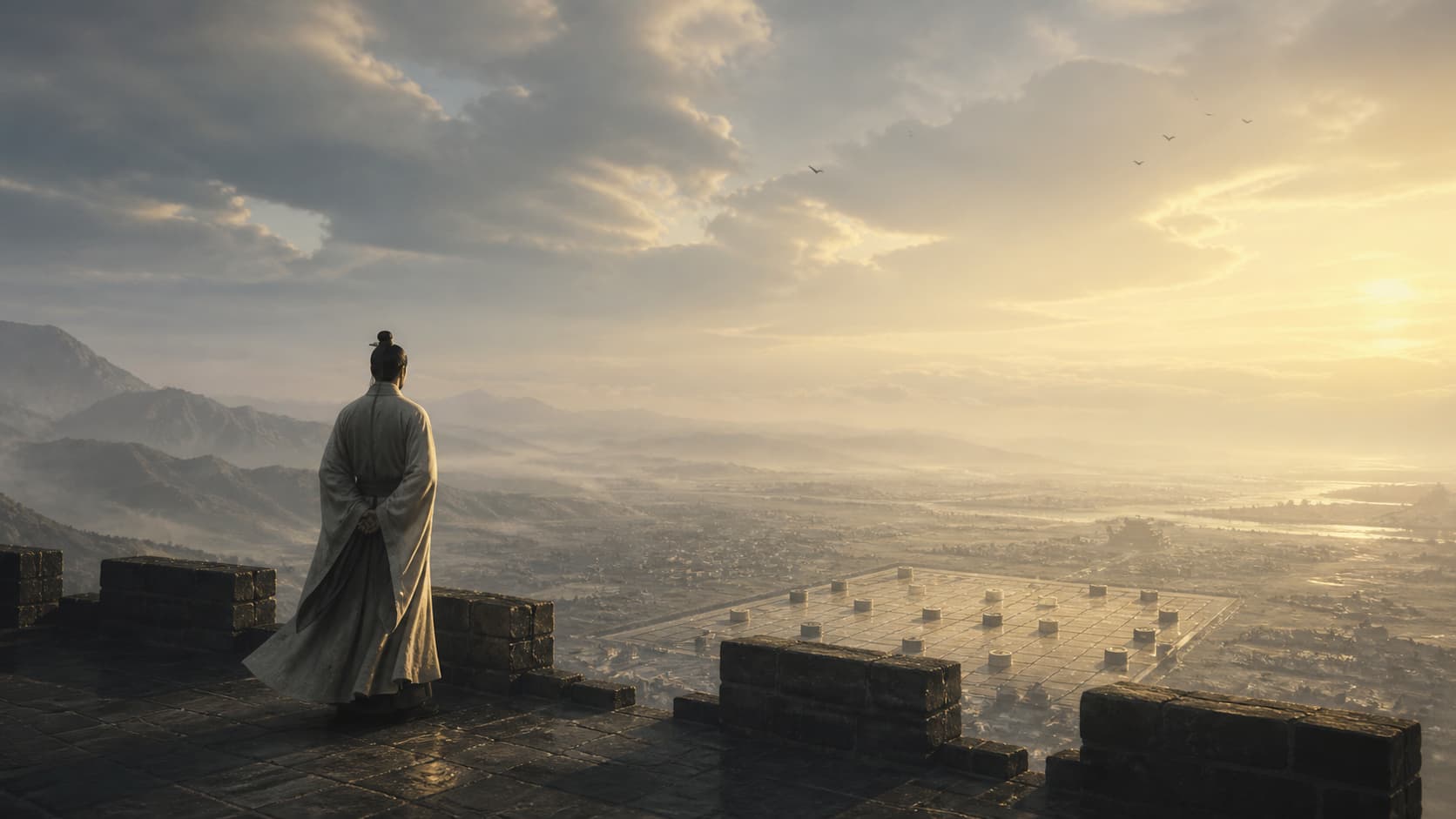
The highest victory isn’t winning the fight. It’s making your opponent realize you were never on the board.
What actually crushes you isn’t the opponent. It’s the voice inside your head saying “I have to fight this.”
There was a product manager at our company who spent last year fighting another team for the same project. Every recurring meeting they’d go head-to-head. Afterward they’d stay up late polishing their proposals so they could tear into the other side the next week. After two weeks both had visibly lost weight. Then year-end strategy adjustments came around and the boss announced the entire line was being cut.
This kind of thing happens in companies all the time. Why?
Maybe the answer is hidden in The Art of War, written 2,500 years ago.
If you’ve been agonizing over things like this lately: that colleague who’s always hard on you publicly tore your proposal apart again — should you tear his apart next time? The boss handed an opportunity to the person you don’t get along with — should you fight to outshine him? A project that’s gone two years without results, and the boss says one more year — should you keep going? This 2,000-year-old book might give you a different answer.
Sun Tzu left three layers of retreat: don’t step onto the field, don’t fight head-on, don’t get tangled up. These three correspond to three chapters in his book: Tactical Dispositions, Attack by Stratagem, and Waging War. Read separately, they’re three sets of tactics. Read together, they form one philosophy of life. Call it “anti-attritionism.”
First, Make Yourself Impossible to Beat
The chapter Tactical Dispositions opens with this line:
The good fighters of old first put themselves beyond the possibility of defeat, and then waited for an opportunity of defeating the enemy. To secure ourselves against defeat lies in our own hands, but the opportunity of defeating the enemy is provided by the enemy himself.
In plain English: the people who were actually good at war didn’t first think about how to win. They first made themselves impossible to defeat, and then waited for the opponent to expose a weakness. Whether you can avoid losing is up to you. Whether you can win depends on whether the opponent gives you an opening.
Sun Tzu also said:
What the ancients called a clever fighter is one who not only wins, but excels in winning with ease. Hence his victories bring him neither reputation for wisdom nor credit for courage.
This is the opposite of the underdog comeback stories we grew up hearing. Comeback stories are always about last-minute reversals, the small beating the big, victory in the final second. But people who are actually good at fighting always win the easy fights. So they win without fame, without spectacular feats.
“Winning dramatically” isn’t the mark of a master. It’s a preview of failure. Real masters win in the most boring way possible, because the outcome was already decided before the fight started.
The winning army first realizes the conditions of victory, and then fights; the losing army fights first, and then seeks victory.
The winning army confirms it can win, then fights. The losing army charges in first and gambles on whether it can win.
This reminds me of Buffett’s investing rule: Rule No. 1, never lose money. Rule No. 2, never forget Rule No. 1. Most retail investors think about how to win big. Buffett first thinks about how not to lose. Stacking structural advantages matters more than any one brilliant move.
Applied to individuals it gets concrete: your core competence, your cash reserves, your health, your key relationships. These are the “secure yourself” parts. First make yourself unable to lose, then go fight the easy fights.
The onrush of a conquering force is like the bursting of pent-up waters into a chasm a thousand fathoms deep.
Real victory looks like releasing pent-up water from a thousand-fathom height into a chasm. It doesn’t look heroic at all, because the force is already there. Winning is just the result.
The real winners win before the fight even starts.
Don’t Fight Him on His Home Turf
Tactical Dispositions is about pre-battle preparation. But what if the other side really comes for you? You can’t dodge forever. That brings us to Attack by Stratagem.
The core thesis of Attack by Stratagem is one line:
To fight and conquer in all your battles is not supreme excellence; supreme excellence consists in breaking the enemy’s resistance without fighting.
Winning a hundred battles out of a hundred isn’t the highest level. Making your opponent submit without fighting is. Hence:
Thus the highest form of generalship is to balk the enemy’s plans; the next best is to prevent the junction of the enemy’s forces; the next in order is to attack the enemy’s army in the field; and the worst policy of all is to besiege walled cities.
Four levels, smartest to dumbest. This ranking maps directly onto workplace competition.
Besieging cities is the dumbest: fighting your opponent on their home turf.
Going up against a PowerPoint master at PowerPoint, fighting for airtime in meetings against someone whose whole skill is talking, debating deployment details with a senior backend engineer — that’s besieging a city. Sun Tzu put it bluntly:
The rule is, not to besiege walled cities if it can possibly be avoided. The preparation of mantlets, movable shelters, and various implements of war, will take up three whole months; and the piling up of mounds over against the walls will take three months more. The general, unable to control his irritation, will launch his men to the assault like swarming ants, with the result that one-third of his men are slain, while the town still remains untaken. Such are the disastrous effects of a siege.
The cost of a siege is one-third of your soldiers dead, with the wall still standing. That’s the order of magnitude when you act on impulse. You see them beat you on their home turf, so you decide to take them down on their home turf. The result is mutual exhaustion. Bleed to bleed them. Walk away with nothing.
Attacking the army is the next dumbest: competing on projects head-to-head.
A lot of people think, “I won’t fight him on his strengths. I’ll find another project to win on.” They think they’ve stepped out of the siege. But they’re still doing the same thing — chasing the same KPI, going to the same boss for credit. Both end up working themselves into the ground while the boss applauds and quietly picks the better performer. The one who got dropped still thinks he lost because he didn’t try hard enough.
You think you escaped the siege. You just moved to another city to keep besieging.
Attacking alliances is double-edged: winning by isolating the opponent.
Office politics, building alliances, message-passing, taking sides — that’s all attacking alliances. This path can work in the short term. The cost is that you have to keep pouring energy into maintaining the political web. Effective for a while; over time it traps you. Because your wins and losses are now tied to the political map, not to what you actually do. A lot of smart people don’t bother — not because they’re noble, but because they’ve seen the compounded return on this path is negative.
Balking the plans is the highest: stepping outside the frame and letting the opponent burn themselves out.
What is “balking the plans”? At its core: foiling the enemy’s strategic intent. Applied to the workplace, it’s one line: find your own unique value and step out of the adversarial frame.
You don’t take the fight. You don’t fight him on his battlefield. You go do something he can’t do, or go somewhere he doesn’t reach. He spends massive energy positioning to take you down, and you’re not even on the board. He gets no feedback, starts feeling anxious, starts burning energy. In the end the one who gets hollowed out is him, not you.
The highest victory isn’t winning the fight. It’s making your opponent realize you were never on the board.
This logic shows up clearly in business. Early Pinduoduo didn’t fight Alibaba head-on in tier-1 e-commerce. It went into the lower-tier markets. By the time Alibaba reacted, Pinduoduo had grown up on a different board. Early ByteDance didn’t fight Tencent on social. It came in through information feeds. By the time Tencent realized it had to fight, it found this wasn’t even the same game.
Therefore the skillful leader subdues the enemy’s troops without any fighting; he captures their cities without laying siege to them; he overthrows their kingdom without lengthy operations in the field. With his forces intact he will dispute the mastery of the empire.
Subdue without fighting. That’s the highest level. This connects right back to Tactical Dispositions. The reason you can “not take the fight” is that you’ve already “secured yourself against defeat.” If you don’t have your own base, no differentiated value, nowhere to retreat to, you have to take the fight. The “balking the plans” option isn’t even available to you. So Tactical Dispositions is the foundation. Attack by Stratagem is the choice.
If You Must Fight, Fight Fast — Never Drag It Out
Best is not stepping onto the field. Once you’re on it, best is not fighting head-on. But what if both retreats are sealed off and you really have to fight?
Sun Tzu’s answer in Waging War:
In the operations of war, where there are in the field a thousand swift chariots, ten thousand heavy chariots, and a hundred thousand mail-clad soldiers, with provisions enough to carry them a thousand li, the expenditure at home and at the front, including entertainment of guests, small items such as glue and paint, and sums spent on chariots and armour, will reach the total of a thousand ounces of silver per day. Such is the cost of raising an army of 100,000 men.
The moment fighting starts, it’s a thousand ounces of silver a day. Therefore:
In war, then, let your great object be victory, not lengthy campaigns. Thus, though we have heard of stupid haste in war, cleverness has never been seen associated with long delays.
Better a clumsy quick win than a clever long delay. Nobody has ever heard of a long war that benefited the country.
This reminds me of a business insight: the best business model isn’t the one that earns the most. It’s the one you only have to invest in once.
Write a book. Record a course. Build a SaaS product. Once the upfront work is done, the marginal cost is near zero, and the rest is passive income. That’s Sun Tzu’s “stupid haste” — looks clumsy upfront, in once, then ride the compounding.
Again, if the campaign is protracted, the resources of the State will not be equal to the strain. Now, when your weapons are dulled, your ardour damped, your strength exhausted and your treasure spent, other chieftains will spring up to take advantage of your extremity.
Drag it out long enough, your blade dulls, your edge dulls, your money runs out.
A project that doesn’t make money for a long time will drag down the whole company.
For an individual, the “thousand ounces a day” isn’t real money. It’s time and attention. A job that drains you every day and leaves nothing accumulated is the personal version. The personal solution is one word: leave. When you see things going wrong, stop. Don’t let sunk cost hold you hostage. A lot of people don’t lose because they chose wrong. They lose because they chose wrong and refused to admit it. As for what you fight with after retreating? The answer is in the previous chapter.
The AI era actually favors small, agile, single-person operations.
The times are changing. Sun Tzu’s “thousand ounces a day” was a real cost in the industrial age — feeding 100,000 troops took 100,000 mouths’ worth of food, building software took an engineering team of dozens. AI rewrites that cost structure. One person plus a few AI tools can do what ten people used to do. The cost of “transporting provisions a thousand li” gets dissolved by technology.
This makes something previously impossible now possible: you don’t need to wage population warfare. You can run small, agile projects — light to operate, fast to decide, no long campaigns. You no longer need 100,000 mail-clad soldiers and a thousand-li supply line to sustain a business. In this era, Sun Tzu’s “speed is what matters in war, not duration” gets amplified by technology into a new survival strategy: use the fewest resources, get to a verdict the fastest, and if it’s not working, walk away immediately.
Sun Tzu closes the chapter well:
Thus it may be known that the leader of armies is the arbiter of the people’s fate, the man on whom it depends whether the nation shall be in peace or in peril. In war, then, let your great object be victory, not lengthy campaigns.
Looking back at all three chapters, Sun Tzu is talking about one thing: the key to winning isn’t fighting harder. It’s fighting less.
But “not fighting” isn’t lying down. Securing yourself against defeat takes accumulation. Subduing without fighting takes judgment. Speed over duration takes execution. This philosophy is much harder than going head-to-head.
Back to that product manager. He didn’t lose to his opponent. He lost to the belief that he had to take the fight.
What actually crushes you isn’t the opponent. It’s the voice inside your head saying “I have to fight this.”
Change the battlefield. Or simpler — don’t step onto it.