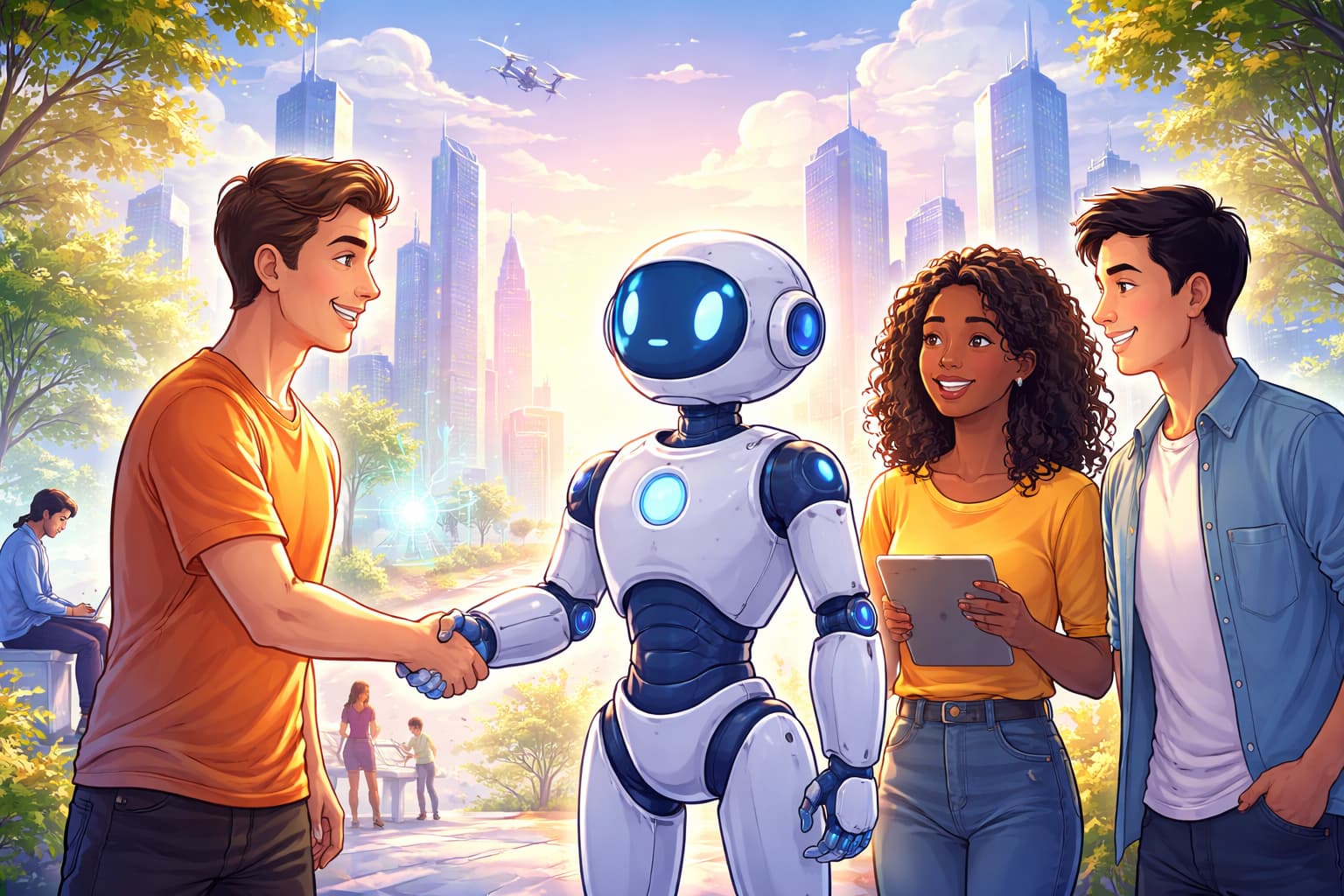
No Need to Fear AI: Why Humanity Will Thrive in the Age of Artificial Intelligence
Working to survive is not a law of nature. It is a social agreement we can change.
The real threat is not AI taking over. It is a tiny fraction of humanity using AI to control everyone else.
Modern capitalism turns people into useful tools. AI strips away our usefulness as low-level tools, and that is a brilliant thing.
Our current social contract, the eight-hour workday, and getting paid based on labor are the horse’s rear end of our time. The giant rocket of AI is currently restricted by the track width of the old industrial age.
If we tie AI Agents to citizenship and rewrite the rules of property and wealth distribution, we can permanently free humans from being treated as tools.
We do not predict the future. We define it. The historical railroad switch is right in front of us, and it is time to pull it.
Me: I haven’t seen you around much lately, Michael. I ran into your agency partner last week. He said you barely look at AI product pitches anymore and just stay home writing all day.
Michael: Yeah, I reviewed a ton of AI projects and suddenly got inspired.
Me: I’ve been talking to engineers at the big tech firms recently. You can feel the anxiety in the air.
Michael: That makes sense. AI is evolving incredibly fast. Machines are smarter and cheaper than people. Everyone is terrified of losing their jobs and their dignity. People wonder if society will collapse into a depression or if we will become useless dependents.
Me: All that anxiety assumes one basic rule. People think you have to trade labor for the right to live, and that tomorrow’s rules will be exactly the same as today’s.
Michael: But that is exactly what we can change. The rules about who owns what and who deserves what have shifted drastically throughout history. AI is handing us a historical opportunity to rewrite the rules of the game. Do you know how they decided the width of the solid rocket boosters on the US Space Shuttle? The story goes that it traces all the way back to the wheelbase of Roman chariots. And that specific width just happened to be the size of two horses standing side by side. Once a standard gets baked into an industry, it sticks around forever, even if it is terribly inefficient. Economists call this the lock-in effect. Today’s social contract, the eight-hour workday, and wage labor are the horse’s rear end of our generation. The giant rocket of AI is currently squeezed onto the narrow tracks of an outdated industrial society.
Me: Path dependence. We are actually training AI using human thought processes, aligning it with human language and values. This isn’t because the human brain is the ultimate intelligent structure in the universe. It is because human cognitive frameworks are becoming the new wheelbase for AI.
Michael: Exactly. In the philosophy of mind, there is something called the extended mind thesis. If an external tool tightly couples with human cognitive processes, the boundaries of the mind don’t stop at the skin and skull. AI is not some alien opponent. It is an extension of human cognition, and it is bound to run along the tracks human civilization has already laid down.
Me: What about wealth? Is AI an extension of our ability to generate wealth?
Michael: Let’s look at Marx’s historical materialism. Marx argued that the relations of production must adapt to the development of productive forces. The definition of property is essentially a constantly evolving relationship of production. Back in the Stone Age, a caveman’s property was whatever he could physically carry. Later, it evolved so a landlord could own thousands of acres.
Me: But the landlord couldn’t carry the land. His ownership came from a piece of paper, a legal system, and the agreement of everyone around him. I remember modern legal theory describing ownership as a bundle of rights.
Michael: Right. The land stayed the same, but the concept of owning it changed. The economist Harold Demsetz pointed out that when new external factors arise, property rights are redefined to organize resources better. Ownership has never been a law of nature. It is a social contract. So in the AI era, computing power, data rights, and the revenue generated by Agents become the new forms of property. It is just the latest chapter in the same old story.
Me: Following that logic, we can shatter the deeply ingrained belief that a person only has value if they work.
Michael: Absolutely. A king’s power and wealth came from his bloodline. A landlord’s income came from owning land. Economics calls this economic rent. It is income based on exclusive institutional rights, not actual physical labor. The idea that you must contribute to get paid is definitely not a natural law. Just look at free public education, social security, or universal healthcare in Europe. Those systems are already breaking down that old consensus.
Me: That reminds me of Zhuangzi. Everyone knows the usefulness of the useful, but nobody knows the usefulness of the useless. Modern capitalism alienates people into tools. AI comes along and strips away our value as low-level tools, and that is actually a good thing. Let AI handle the practical labor, and humans can return to a natural state of being. When people aren’t forced to be a workforce, citizenship itself becomes the new anchor for wealth distribution. It frees people to pursue creativity and aesthetics. Using citizenship as that anchor, education is a perfect benchmark for how we design future products. Society links the right to education with the person. Why couldn’t we link an AI Agent to a person? It wouldn’t just be an app on a phone. It would be a digital avatar claiming rights on behalf of the citizen in the digital economy.
Michael: We completely could. The OECD defines Agentic AI as systems that can set goals, make decisions, and execute tasks autonomously. Imagine a world where every citizen gets assigned an AI Agent the moment they reach adulthood. These Agents belong to the person, just like the skills they learned in school. The Agent goes out to work in the digital economy, creates value, and the income goes straight to the human it is tied to. Just like society manages education and healthcare, we could build a system that guarantees everyone the right to an intelligent proxy.
Michael: If we establish those two foundations, redefining property and linking Agents to individuals, I predict citizens will see three major dividends in the AI era. First is the resource dividend. Energy, minerals, spectrum, carbon emissions, and even space get redefined as public assets owned by everyone. It would pay out an economic rent dividend, like the Alaska Permanent Fund or Norway’s sovereign wealth fund. Second is the Agent dividend. Everyone essentially gets a tireless digital employee to make money for them from birth. Third is the productivity dividend. AI makes the economic system exponentially more efficient, creating massive abundance across society.
Me: The logic is airtight. But in reality, people are mostly terrified of the sci-fi movie scenario where AI turns around and controls us.
Michael: I think they are afraid of the wrong thing. Historical slave revolts and labor movements happened because the exploited groups had class consciousness, political demands, and the ability to organize. We won’t become slaves to AI because AI is a tool, not a master. It has no political demands and no class consciousness. The real threat is not AI controlling humans. The threat is a tiny group of humans controlling the AI, and using it to control the rest of humanity. This is a political economy problem about distribution and monopolies. If we build the right governance framework, an AI-driven production system will be infinitely more stable than any labor-intensive society in history.
Me: Ultimately, it comes down to who makes the rules. The universe has no inherent meaning. Humans create the meaning.
Michael: Exactly. Every technological revolution redistributes narrative power. The Industrial Revolution allowed capitalists to build the narrative of getting rich through hard work. The atomic bomb gave the US the power to define the post-war international order. AI is the steam engine and the atom bomb of our generation. It can reinforce old narratives or destroy them entirely. Whoever masters AI first gets the power to dictate the rules of the next era.
Me: Laozi wrote in the Dao De Jing about molding clay into a vessel. It is exactly because the center is empty that the vessel is useful. Current AI technology is like wet clay. We are probably in the very last window of time to mold it and shape its internal space and rules.
Michael: And it is the most critical window. We have to use AI itself to build a new narrative that benefits all of humanity. We must clearly define the link between Agents and individuals, and establish citizen ownership in the digital space. If we wait until the clay is baked, the technological benefits will be monopolized by a few oligarchs and locked in as an unbreakable foundation of exploitation. If we try to change it after that, we will have to break it with blood.
Me: If we code our definitions of AI, property, and civil rights into the system today, they become irreversible infrastructure. Just like the width of the space shuttle’s rocket boosters.
Michael: Exactly. The future isn’t predicted. It is defined. The historical switch is right in front of us, and it is time to pull it.
Source:
Don’t Fear AI: Why Humanity Will Thrive in the Age of Artificial Intelligence