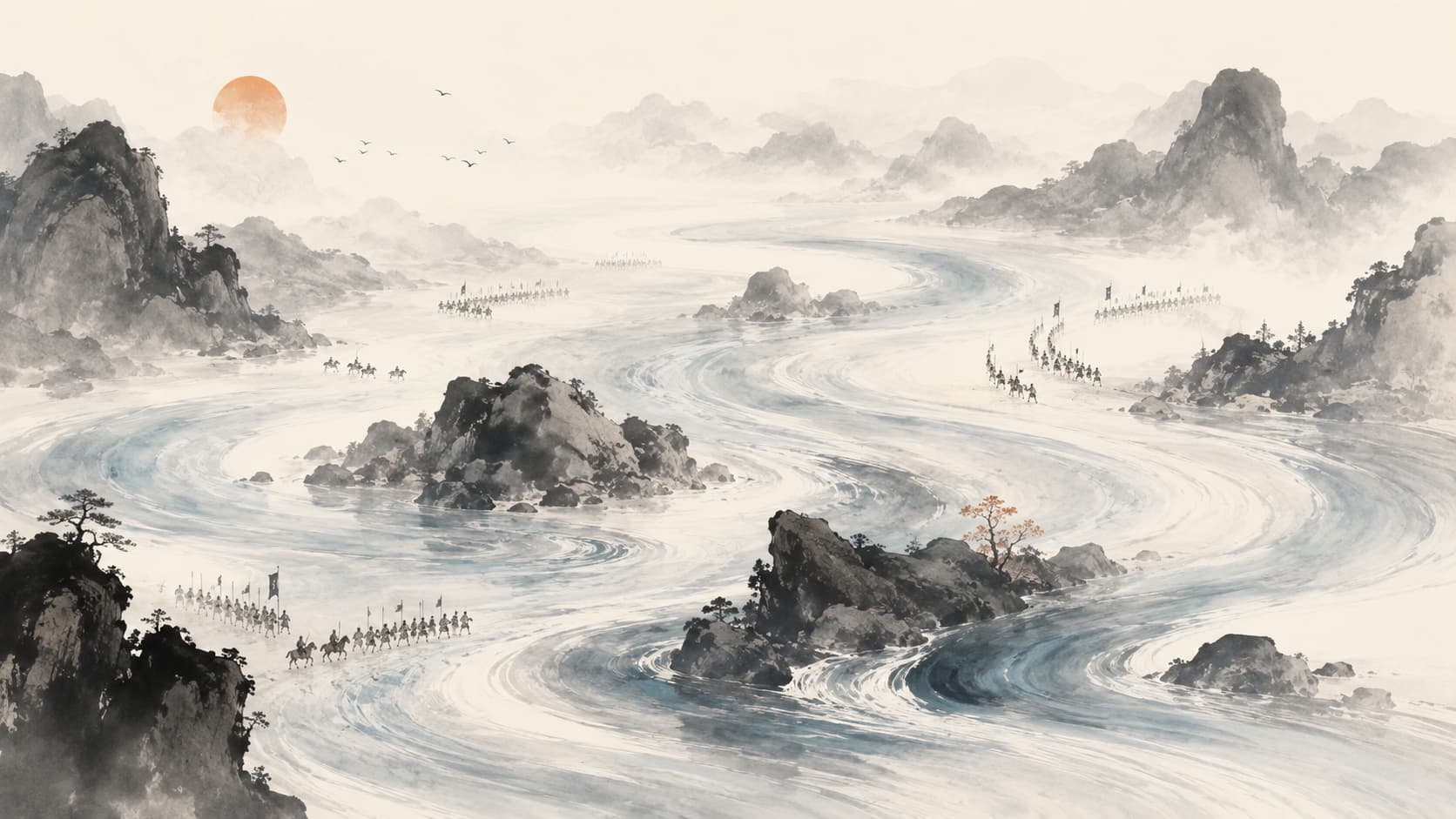
Sun Tzu: When You Have to Fight, Pull These Three Levers
The real fighters are always the ones moving the opponent, never the ones being moved.
Winners aren’t stronger. They’re better at waiting for the right moment.
Real winners never fight on their opponent’s battlefield.
Before Pinduoduo went public, founder Huang Zheng said one line: we don’t fight Alibaba on its home turf. In the same period, Jumei Youpin tried to expand from its beauty moat into full-category e-commerce against Tmall. By 2020 it had gone private off the NYSE.
Same arena. One refused the hard fight and won. The other went all-in across the line and lost.
This was the subject of the last post — Sun Tzu’s “Way”: don’t lose first, don’t fight head-on, don’t get tangled up. But “the Way” is a luxury. You’re not Huang Zheng. You don’t get to pick your battlefield. Your boss has dumped the project on you. The market is already in motion. The opponent is already in front of you. You have no choice.
So now what?
Sun Tzu left three levers in the book: momentum (shi), tempo, and the general’s character. Three levers map to six chapters: Energy and Weak Points and Strong write about momentum, Maneuvering writes about tempo, The Nine Variations / Terrain / The Attack by Fire write about the general’s character.
Momentum
A salesperson who got fired from a previous company joined a new one and became top 1 in three months. Same person, same playbook, revenue jumped 20x. What changed wasn’t him. It was the lane he stepped into — the product, the comp structure, the field he was now embedded in.
The Energy chapter speaks to this directly:
The clever combatant looks to the effect of combined energy, and does not require too much from individuals. Hence his ability to pick out the right men and utilize combined energy.
A real commander pins victory on shi (momentum), not on demanding heroism from every soldier. What he actually does is pick the right people and put them inside the right energy.
This line breaks the hero myth. A team wins not because it has ten exceptional people, but because it has a structure where ordinary people can perform. Sun Tzu follows it with a vivid image:
Thus the energy developed by good fighting men is as the momentum of a round stone rolled down a mountain thousands of feet in height.
Roll a round stone down a thousand-fathom mountain. It rolls fast and hard on its own. You don’t need to push the stone. It’s already inside the momentum.
That person on your team who seems mediocre — maybe he isn’t mediocre. Maybe you put him on flat ground and asked him to roll by himself. Change the slope and he might be a different person.
The Energy chapter also has a key paired concept: the direct (zheng) and the indirect (qi):
In all fighting, the direct method may be used for joining battle, but indirect methods will be needed in order to secure victory.
The frontal engagement is the direct. The flanking maneuver is the indirect. These two aren’t either/or. They happen simultaneously. The closest business analogy is the dual-line structure of core business + innovation: the core steadily funds the cash flow (direct), while a side line tries new things (indirect).
A company with only the direct calcifies over time. A company with only the indirect runs out of cash quickly. That’s why Tencent has WeChat and still builds games. Why ByteDance has Douyin and still builds CapCut.
Then the Weak Points and Strong chapter pushes momentum toward initiative:
Whoever is first in the field and awaits the coming of the enemy will be fresh for the fight; whoever is second in the field and has to hasten to battle will arrive exhausted.
Whoever arrives first at the battlefield is at ease; whoever arrives second is worn out. So the core thesis of Weak Points and Strong is one sentence:
Therefore the clever combatant imposes his will on the enemy, but does not allow the enemy’s will to be imposed upon him.
The real fighter is always the one moving the opponent, never the one being moved.
When the iPhone launched in 2007, Nokia’s global handset market share was over 50%. For the next six years, every move Nokia made was a reaction: first mock touchscreens as unreliable, then rush out a touchscreen Symbian, then announce a switch to Microsoft WP, then sell the entire handset business to Microsoft. At the sale press conference, Nokia’s CEO said one line: we didn’t do anything wrong, but we lost.
You didn’t do anything wrong, but every move you made was after the other side moved first. That is being moved.
The Weak Points and Strong chapter has another valuable passage on the trap of even defense:
For should the enemy strengthen his van, he will weaken his rear; should he strengthen his rear, he will weaken his van; should he strengthen his left, he will weaken his right; should he strengthen his right, he will weaken his left. If he sends reinforcements everywhere, he will everywhere be weak.
Defending everywhere is defending nowhere. Pushing everywhere is pushing nowhere.
This shows up constantly in startups: you cannot compete with a giant across all dimensions at once. You can only take one dimension to the extreme and accept being weak everywhere else. Early Pinduoduo skipped quality control, skipped logistics, skipped brand. It did one thing: low price. It accepted being mocked as a knockoff because it knew it only needed to win on one line.
People who try to do everything well end up doing nothing well. Pick your primary battlefield and let yourself be rough on the rest. That’s how you win.
The Weak Points and Strong chapter closes with a line almost everyone has heard:
Just as water retains no constant shape, so in warfare there are no constant conditions. He who can modify his tactics in relation to his opponent and thereby succeed in winning may be called a heaven-born captain.
No fixed formation. No fixed playbook. In competition, you adapt.
Tempo: Fast, Slow, Stillness
The Maneuvering chapter opens by admitting tempo is the hardest thing:
The difficulty of tactical maneuvering consists in turning the devious into the direct, and misfortune into gain.
The detour becomes the shortest route. The trouble becomes the gain. Both require an extraordinary command of tempo. Fast is not always good.
Thus, if you order your men to roll up their buff-coats and make forced marches without halting day or night, covering double the usual distance at a stretch, doing a hundred LI in order to wrest an advantage, the leaders of all your three divisions will fall into the hands of the enemy.
You march your troops day and night for a hundred li to seize an opportunity, and the result is all three generals captured. Why? The troops are scattered, the supplies are gone, the tempo is wrecked. Sun Tzu’s ideal tempo:
Let your rapidity be that of the wind, your compactness that of the forest. In raiding and plundering be like fire, in immovability like a mountain. Let your plans be dark and impenetrable as night, and when you move, fall like a thunderbolt.
Fast like wind, impossible to catch. Slow like a forest, calm and steady. Attacking like fire, unstoppable. Still like a mountain, unmovable. Hidden like dark clouds, unreadable. Moving like thunder, too fast to react.
None of the six states is permanent full-speed.
Sun Tzu’s method is what he calls the Four Disciplines:
A clever general avoids an army when its spirit is keen, and attacks it when it is sluggish and inclined to return. This is the art of studying moods. Disciplined and calm, to await the appearance of disorder and hubbub amongst the enemy: this is the art of retaining self-possession. To be near the goal while the enemy is still far from it, to wait at ease while the enemy is toiling and struggling, to be well-fed while the enemy is famished: this is the art of husbanding one’s strength. To refrain from intercepting an enemy whose banners are in perfect order, to refrain from attacking an army drawn up in calm and confident array: this is the art of studying circumstances.
Avoid the opponent at his peak. Wear him down. Wait until he shows fatigue and disorder.
Winners aren’t stronger. They’re better at waiting for the right moment.
In the End, What Decides the Fight Is the Person
At 2 a.m. four people were still in the office reworking a proposal due the next day. One of them, named Wang, said this was the third night this week he’d left after midnight. The next day the proposal went out. The other side replied: “Let us think about it more.”
In that moment I thought of a phrase from The Nine Variations: “the reckless can be killed.”
The core of The Nine Variations is Sun Tzu’s summary of the personality traps of a commander:
There are five dangerous faults which may affect a general: recklessness, which leads to destruction; cowardice, which leads to capture; a hasty temper, which can be provoked by insults; a delicacy of honor which is sensitive to shame; over-solicitude for his men, which exposes him to worry and trouble. These are the five besetting sins of a general, ruinous to the conduct of war.
Each of the five is a double-edged sword because each one looks like a virtue:
- Recklessness: treating “throwing yourself in” as a virtue, charging at every problem. The opponent only needs to dangle a bait that looks important, and you dive in headfirst. What Wang threw himself into that week wasn’t the proposal. It was the five-character belief “I must close this.”
- Cowardice: too afraid of failure, won’t act at the critical moment. The window opens and you don’t move because you’re afraid of losing. Then you spend the rest of the year regretting it.
- Hasty temper: short fuse, gets baited. The opponent throws one provocation and you crack. Every judgment from that point is held hostage by emotion.
- Delicacy of honor: cares too much about reputation, falls apart when smeared. A rumor, a misunderstanding, a piece of public criticism — and you drop everything to clear your name. The work you were supposed to do stops.
- Over-solicitude: wants to protect everyone, gets dragged down from every direction. Any subordinate’s plea makes you soft. You can’t bear to kill any project. In the end every plate crashes together.
Sun Tzu’s verdict is cold: “These are the five faults of a general.” They are not neutral personality traits. They are faults, mistakes. A leader who can keep winning has to be aware of where these five live inside him, and actively hedge against them.
The Nine Variations also has an excellent decision principle:
Hence in the wise leader’s plans, considerations of advantage and of disadvantage will be blended together.
Smart people consider both the upside and downside at the same time. When it looks favorable, think about the harm to stay alert. When it looks harmful, think about the upside to unblock yourself. This is the same logic as the modern “find the opposing view” practice: always seek a perspective that contradicts your own conclusion.
The Terrain chapter is nominally about classifying terrain, but its real essence is a single line about the general’s character:
The general who advances without coveting fame and retreats without fearing disgrace, whose only thought is to protect his country and do good service for his sovereign, is the jewel of the kingdom.
Advance without chasing reputation. Retreat without fearing blame. The only standard is to preserve the people and serve the organization. That kind of general is the jewel of the kingdom.
In the workplace, most people invert this: advance only for fame, retreat only to avoid blame. When it’s time to step up, they only pick what looks good and dodge what doesn’t. When it’s time to pull out, they refuse to pull out even on a clearly dying project, because retreating would mean someone tallying the cost. The result: every organization is full of hard problems no one will take, and dying projects no one will kill.
Terrain Chapter
The Terrain chapter also has a great passage on leading people:
Regard your soldiers as your children, and they will follow you into the deepest valleys; look upon them as your own beloved sons, and they will stand by you even unto death.
But many people miss the line that immediately follows:
If, however, you are indulgent but unable to make your authority felt; kind-hearted but unable to enforce your commands; and incapable, moreover, of quelling disorder: then your soldiers must be likened to spoilt children; they are useless for any practical purpose.
Generous but unable to command. Loving but unable to direct. Disorderly but unable to discipline. That becomes spoiled children, useless. Love without principle is indulgence, and indulged teams can’t take the field.
The Attack by Fire
In The Attack by Fire, Sun Tzu leaves two warnings:
Unhappy is the fate of one who tries to win his battles and succeed in his attacks without cultivating the spirit of enterprise; for the result is waste of time and general stagnation.
You win the battle, you take the city. But you don’t reward the people who earned it. That’s called “wasteful stagnation,” and it’s a calamity. Many silent collapses in organizations come from this: after a big win, the boss forgets to celebrate, forgets to pay out, forgets to call out names. The next time he asks people to push hard, no one is willing.
The last warning is one many have heard:
No ruler should put troops into the field merely to gratify his own spleen; no general should fight a battle simply out of pique. Anger may in time change to gladness; vexation may be succeeded by content. But a kingdom that has once been destroyed can never come again into being; nor can the dead ever be brought back to life.
A ruler cannot start a war out of anger. A general cannot commit to battle out of pique. Anger eventually turns into joy. Pique eventually turns into contentment. But a destroyed kingdom cannot come back, and the dead cannot return.
This translates very concretely to today: a colleague publicly contradicts you in a meeting — don’t fire back in the next second. A group chat dumps blame on you — don’t write a long reply in the next five minutes. Don’t let the opponent’s provocation drive your tempo. Emotion is the cheapest and most dangerous input to a decision, and Sun Tzu pointed this out more than two thousand years ago.
Compared to the previous post:
- The Way is about not stepping onto the field, not fighting head-on, not getting tangled up.
- The Craft is, once you must step on, fighting well through momentum, tempo, and character.
The Way reduces the number of fights you need to take. The Craft keeps the fights you must take from collapsing.
By the end of the book, what Sun Tzu leaves you is not a set of tactics. It’s a way of living.
Advance and retreat with reason. Tempo at peace with itself. Momentum held in your own hand. Emotion never breached.
Real winners never fight on their opponent’s battlefield.