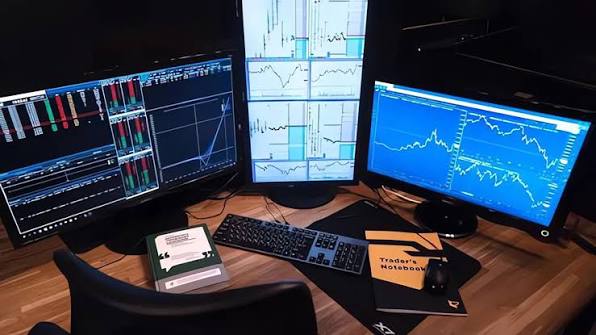
Two Years as a Trader, and Now She Can't Stand Hearing a Sentence Twice
“Could you print two copies of this, black and white, double-sided?”
“We don’t have a color printer.”
“I just want black and white.”
“So how many copies?”
“Two.”
“Single-sided or double-sided?”
”…”
She does a job machines cannot learn. But the job is turning her into a machine.
Cobalt. It is in electric car batteries, in phones, in alloys. Yet if you want to know how much of it actually traded last year, or how the price moved, there is no single place that can give you a complete number. Its trades are too sparse, scattered across bilateral negotiations and long-term relationships. Nothing goes through central clearing. It works like an over-the-counter market.
Angela’s job is to find those data points and work out the answer.
She does a job machines cannot learn. But the job is turning her into a machine.
The day I met her, she had just gotten off work. Her eyes were tired, with faint dark circles underneath. She said it was from staying up late watching the World Cup.
She is a trader in London. Undergrad at Peking University, then a master’s at INSEAD, one of the best business schools in Europe. “I’m not really the competitive type,” she said. She was probably comparing herself, without realizing it, to the very top people at Peking University and INSEAD. “A lot of my classmates landed better jobs than I did.”
Few people know that her undergraduate degree was in literature. Back then she was interested in expression and writing. But for the sake of employment, she picked up a second degree in business analytics along the way. Her first job was in commodities research.
Commodities research is content production, a bit like Bloomberg. The stock trading we know is centrally cleared: massive amounts of trade data flow into one place, and you can see the whole market from your screen. But things like cobalt and rare earths are different. They trade through bilateral negotiation and long-term partnerships, and no single place holds complete data. Researchers have to investigate for themselves: who is buying, who is selling, the market’s mood, even news that has never been digitized at all.
There are two ways to investigate. One is called desk: whatever you can find sitting at a computer. The other is called field: you go there in person, for example visiting a company to find out how much it actually produced and sold this quarter. Take cobalt. Its trades are so sparse that staring at transaction data is not enough. She had to study its suppliers, its traders, its buyers, and piece the whole market together.
Because she found traders more interesting, she jumped to her current company to become one.
She says traders roughly come in three kinds. The first are bank traders, who act like market makers. In her words, “you run a fruit stand, but you don’t grow fruit; you find buyers for the sellers’ fruit.” They earn from flow and the bid-ask spread. The second are hedge fund traders, like stallholders trading on their own account, living off price differences. The third kind is represented by Jump Trading: pure electronic market making, serving no one and betting on no direction, using algorithms to quote bids and asks on a huge range of products across exchanges at once, and relying on extreme speed and enormous volume to capture each tiny spread thousands upon thousands of times.
I asked her: can AI be used in your work right now?
“Not really,” she said. “Most of what I do now is making decisions.”
I pressed further: what if you wrote your workflow into instructions and fed it to an AI? Could it make the decisions for you?
“No.” It came out almost instantly. Then she paused, thought carefully for a while, and said, “Really, no. This market is not fully transparent. It cannot be fully explained by data.”
She said the market occasionally throws up anomalies, but they happen so rarely that they carry no statistical significance, so machines cannot learn a pattern from them. In those moments a trader relies entirely on experience: having lived through something similar before, and judging by instinct.
That is her moat. She does something AI cannot learn, for now.
But this industry pushes people toward becoming machines.
Trading is a race against the clock. You have to talk fast and react fast, and nobody likes hearing a question asked twice. The environment is intensely high-pressure too. The colleague sitting next to her once had a pen holder thrown at her by a senior. When Angela herself first joined, still unfamiliar with the business, she got yelled at and then simply left there, with no one telling her what to do. “I sat at my desk crying all afternoon that day,” she said. “Not a single person around me comforted me. No one even acknowledged me.”
Nearly two years into this line of work, she says she has become very impatient herself. She told a joke:
“Could you print two copies of this, black and white, double-sided?”
“We don’t have a color printer.”
“I just want black and white.”
“So how many copies?”
“If that were me, I would explode on the spot.” She started laughing before she even finished.
She does not like her current job. “The judgments we make from experience aren’t necessarily right either,” she said. She genuinely looks forward to the day AI can truly be brought in, offering a completely different but more efficient way of working. “Though that’s probably a long way off.”